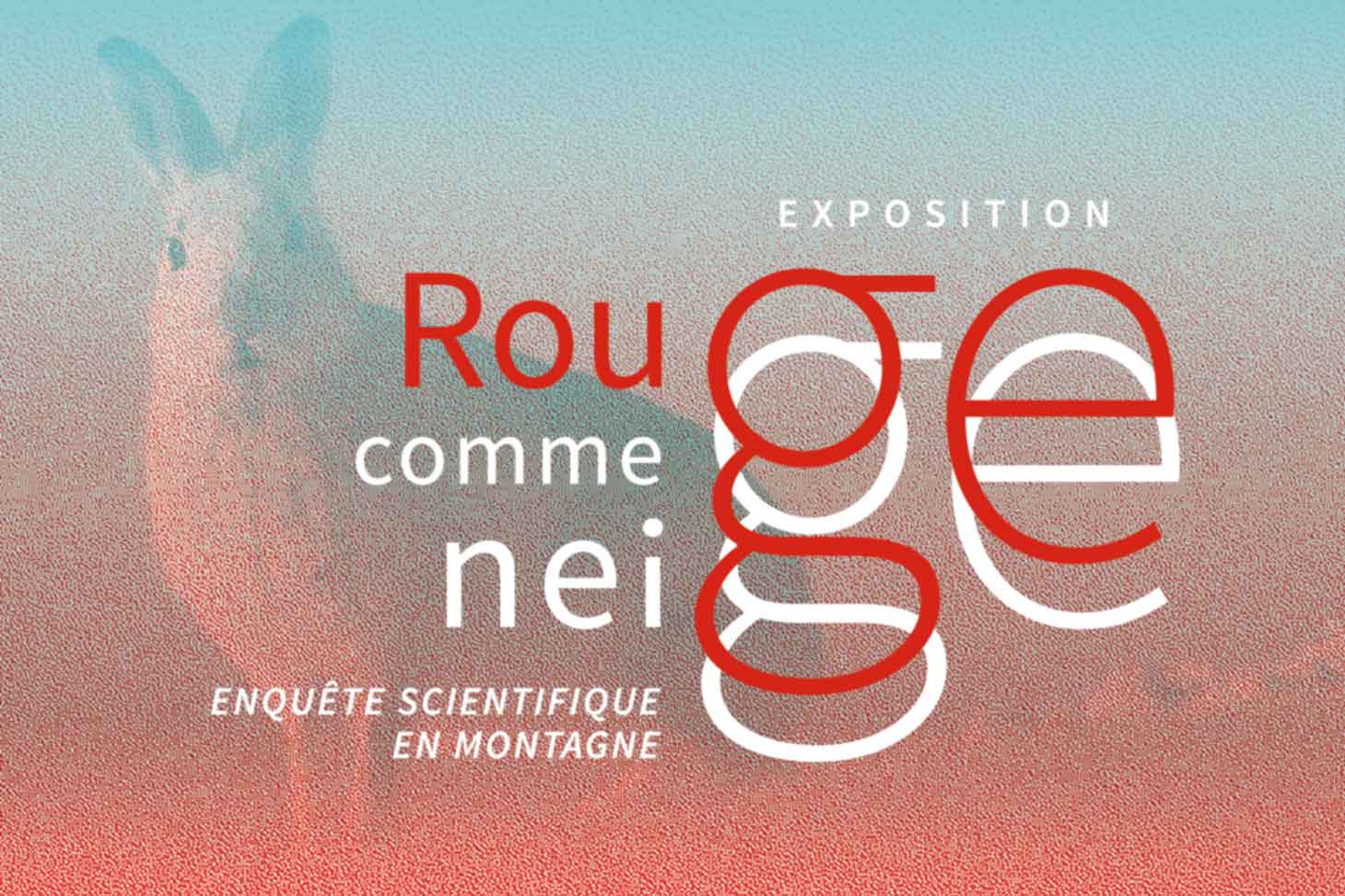
Every spring, at an altitude of over 2,000 meters, some snowfields take on an unexpected color: red. This poetic and intriguing phenomenon takes us on a journey through art, science, and ecology. The exhibition "Red Like Snow - Scientific Investigation in the Mountains" invites visitors to unravel the secrets of colored snow, discover the microorganisms that inhabit it, and immerse themselves in the scientific adventure of the project.
.
Historical objects, models, films, field equipment, works of art, and events surrounding the exhibition will make you see snow like never before.
Don't miss the various events surrounding the exhibition: guided tours, LSF tours, workshops for children, meetings with researchers, conferences, and field collections near the Lautaret garden. The program will be published as it becomes available on the
Complete your visit, from October 22 to November 15, with the photography exhibition "Le sang des névés" (The Blood of the Snowfields) at the Maison Grenoble Montagne.
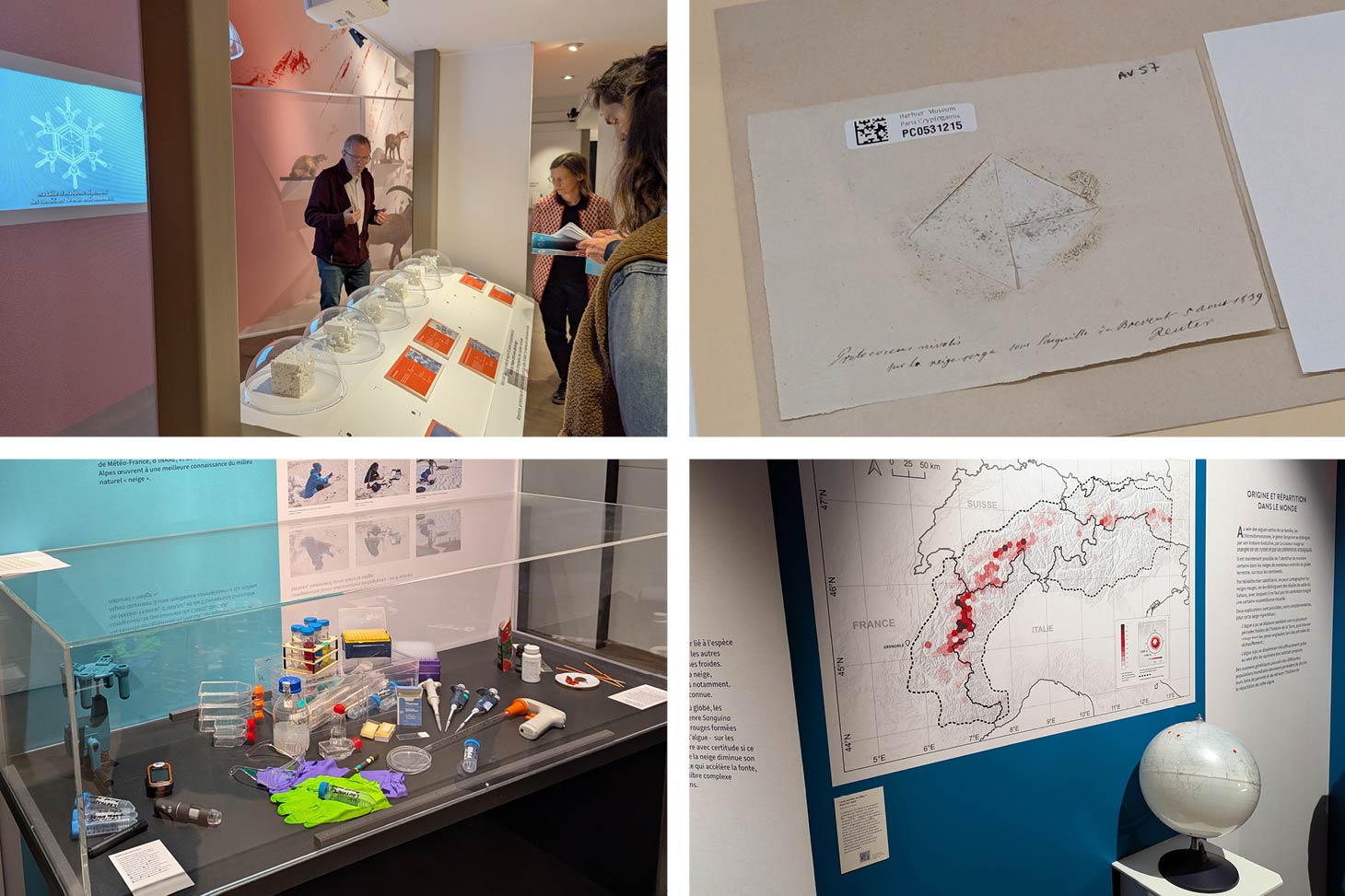
At the top left, Éric Maréchal, CNRS researcher and coordinator of the Alpalga consortium, explains that scientists classify snow according to its thermal and mechanical properties and its physical state. Cubes enlarged to the size of a sugar cube show what "fresh," "transformed," "compact," "crusted," and "powdery" snow looks like. Top right: the first known sample of red snow, collected by Georges François Reuter in 1838 at Mont Brévent. Bottom left: equipment used today to collect and analyze samples of red snow (including equipment loaned by the Lautaret garden). Bottom right: a
map showing the distribution of red snow in the Alps, detected by satellite images, the result of work by Léon Roussel, a doctoral student at the Snow Research Center.
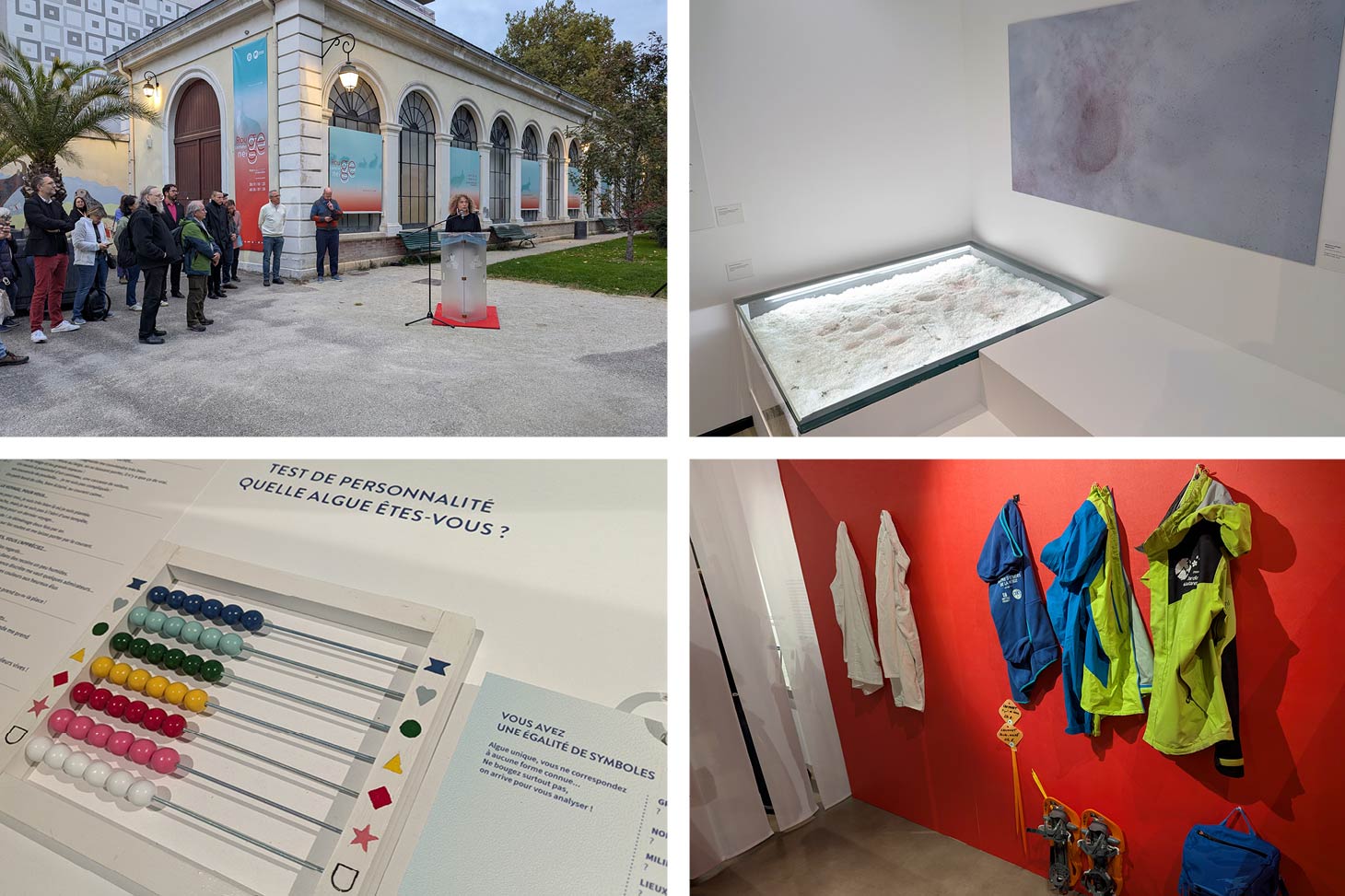
Top left: Speech by Marie Dumont, director of the Snow Research Center, at the exhibition opening on Thursday, October 9, 2025. Top right: Reconstruction and photo of a red algae bloom (
Snowy bloodroot). At the bottom left, a fun game to learn about different types of algae. At the bottom right, an airlock connecting the field to the lab. The items on display here belong to the researchers involved in the exhibition. For example, the jacket on the far right belongs to Jean-Gabriel Valay, director of the Lautaret garden, who participated in the first red algae collections in the French Alps.
You can find out more in the exhibition presentation file, which can be downloaded below. This exhibition was also designed in collaboration with the Alpine Ecology Laboratory, the Snow Study Center, the Institute of Environmental Geosciences (all of these laboratories belong to the Grenoble Observatory of Universe Sciences federation, as does the Lautaret Garden) and the Laboratory of Cellular and Plant Physiology.